Barsoomian thought transference
A Princess of MarsBarsoomian thought transference is both a means of interpersonal knowledge and a practical force in the plot: thoughts can disclose what speech conceals, operate the sealed doors of the Atmosphere Plant, and preserve impressions that a royal psychologist later reads from the dead. John Carter’s arrival exposes an unusual limit to the system. He can perceive a Barsoomian’s thoughts, but the Barsoomian cannot read his; that imbalance gives Carter access to a secret that turns an apparently impregnable prison into an escape route.
Unequal Minds
At the Atmosphere Plant, an unseen host interrogates Carter and concludes that his account is truthful, but that he is not from Barsoom. The host says he can tell from Carter’s brain, internal organs, and heart. When Carter asks whether the host can see through him, the answer defines the boundary of the power: he can perceive everything except Carter’s thoughts, whereas he could read the thoughts of a Barsoomian.
When the host later appears, Carter discovers that the limitation works in the opposite direction too. During their long conversation, Carter can read the old man’s thoughts, while the old man cannot fathom anything in Carter’s mind unless Carter speaks. This is not simply a difference in what the two men choose to reveal. Their mental access is structurally unequal: the Martian can inspect Carter’s body but not his private thought, while Carter can silently inspect the Martian’s intentions.
Carter keeps this advantage to himself. He learns that Barsoomians exercise precise control over their thinking, directing their thoughts with such accuracy that the old man’s mind does not casually expose everything he knows. This control makes thought-reading neither an effortless nor a universally transparent process. Carter has to attend to what enters the old man’s mind, and his success depends on the latter believing that their conversation remains ordinary.
Thought as a Key
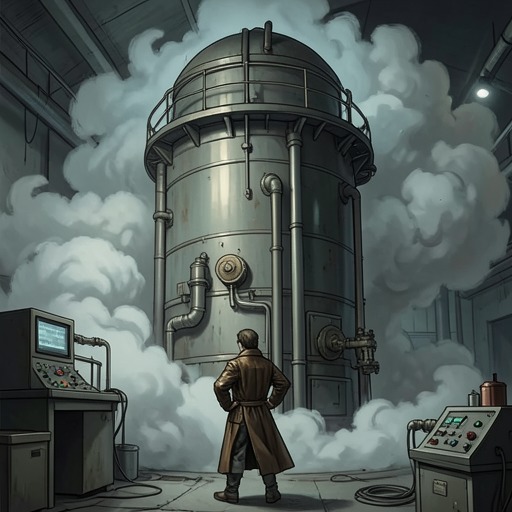
The power becomes a literal instrument of access inside the Atmosphere Plant. Carter discovers that telepathic means manipulate the outer doors: finely adjusted locks respond to a particular combination of thought waves. The doors themselves make the security system tangible. They recede into the wall, slide aside, and shut behind entrants; their great thickness and descending steel cylinders give the hidden mental key a physical consequence.
Carter draws out the crucial combination by asking casually how the old man opened the doors from within. Nine Martian sounds leap into the old man’s mind, then vanish as he answers that the secret must not be divulged. The exchange is a small contest between the question Carter voices and the question his mind is really pursuing. The host’s spoken refusal does not prevent the silent information from reaching Carter.
The old man grows suspicious afterward. Carter reads fear in his thoughts and looks, although his words remain courteous. That contrast closes the gap between private knowledge and outward behavior: mental concealment can be disciplined, but the old man’s suspicion itself is legible to Carter. The host nevertheless promises a letter to an agricultural officer who might help Carter reach Zodanga, leaving Carter with apparent assistance as well as a growing reason to distrust his host.
Escape from the Plant
Carter’s suspicion proves consequential when he sees the old man carrying a thin dagger and sharpening it on a stone. From the old man’s thoughts, Carter learns that he plans to inspect the radium pumps for about thirty minutes and then return to kill him. The danger is therefore revealed not through a confession or an attack, but through Carter’s private access to a plan that has not yet been carried out.
While the old man is away, Carter crosses to the inner door separating him from liberty. He concentrates on its massive lock and sends the nine thought waves against it. The door moves softly toward him and slides aside; he repeats the operation at the remaining portals. Carter and Woola leave the building together. The doors that had confined them become instruments of escape because Carter has acquired the mental pattern that governs them.
The escape does not make Carter secure. He and Woola reach the darkness outside with full stomachs, but little improvement in their prospects. At dawn Carter reaches a crossroads and enters the first enclosure he finds, only to encounter low concrete buildings with heavy doors and no answer to his pounding or calls. Exhausted from sleeplessness, he lies down and orders Woola to guard him. Thought-reading has broken the Plant’s immediate barrier, but it has not ended the dangers of an unfamiliar world.
Reading the Dead
Elsewhere, thought-reading serves a different purpose. After four guardsmen are killed in the palace, Than Kosis asks how a group of six or eight attackers could have entered without being noticed. The royal psychologist, Notan, reports that the impressions he reads in the guardsmen’s dead minds point instead to a single opponent. The dead preserve an account that the living investigators could not obtain by questioning their victims.
Notan describes the assailant as a very tall man wearing the metal of a Zodangan guardsman. The guardsmen’s mental impressions identify someone who fought all four fairly and defeated them through exceptional skill, strength, and endurance. Though dressed in Zodangan metal, the man was unknown in the country and, Notan says, elsewhere on Barsoom. The reading thus turns private mental traces into evidence about the number, appearance, and fighting ability of the intruder.
A princess of Helium, whom Notan has examined and questioned, is a counterexample to effortless access. He says her mind is blank to him because she has perfect control, and he cannot read it. She can report that she witnessed part of the encounter and saw one man fighting the guards, but does not recognize him. Her testimony and the guardsmen’s preserved impressions converge on the solitary attacker without making every witness mentally accessible.
Knowledge, Secrecy, and Power
Across these episodes, thought transference is not just a way of communicating; it changes who can know, conceal, and act. Carter’s unannounced access to the old man’s mind allows him to learn both a lethal intention and the Plant’s door code. The old man’s control over his thoughts, by contrast, is a defense against casual exposure, but it cannot protect the combination once Carter has observed it arise in his mind.
The palace inquiry gives the same mental capacity an institutional use. Notan converts the dead guardsmen’s impressions into an account that challenges the rulers’ initial assumption of a larger force. Yet the princess’s controlled mind marks a limit to that expertise. Thought-reading supplies consequential knowledge, but it does not erase the distinction between minds that can be entered and minds that remain closed.
The narrative’s central irony is that speech can be the least revealing part of an encounter. The old man’s courteous words coexist with a plan to kill Carter, while the old man’s unspoken thoughts disclose the danger. In the palace, the dead cannot speak, yet their impressions are made to testify. Thought transference therefore operates as both vulnerability and evidence: it opens a private channel, but what that channel yields depends on whose mind is accessible, what is deliberately controlled, and who is listening.